Mitsubishi Electric announced the development of a new plate heat exchanger for heat pump¹ equipment used for heating and cooling, achieving approximately three times the heat transfer performance³ of the company’s conventional models.
New Refrigerant Requirements Present New Engineering Challenges
The transition towards carbon neutrality is driving increasingly stringent requirements for refrigerants. This is accelerating the gradual adoption of solutions using refrigerants with a lower Global Warming Potential (GWP). At the same time, greater emphasis is being placed on safety and on optimizing the refrigerant charge within the system.
This is driving the development of heat exchanger designs capable of delivering high heat transfer performance while reducing the required refrigerant charge.
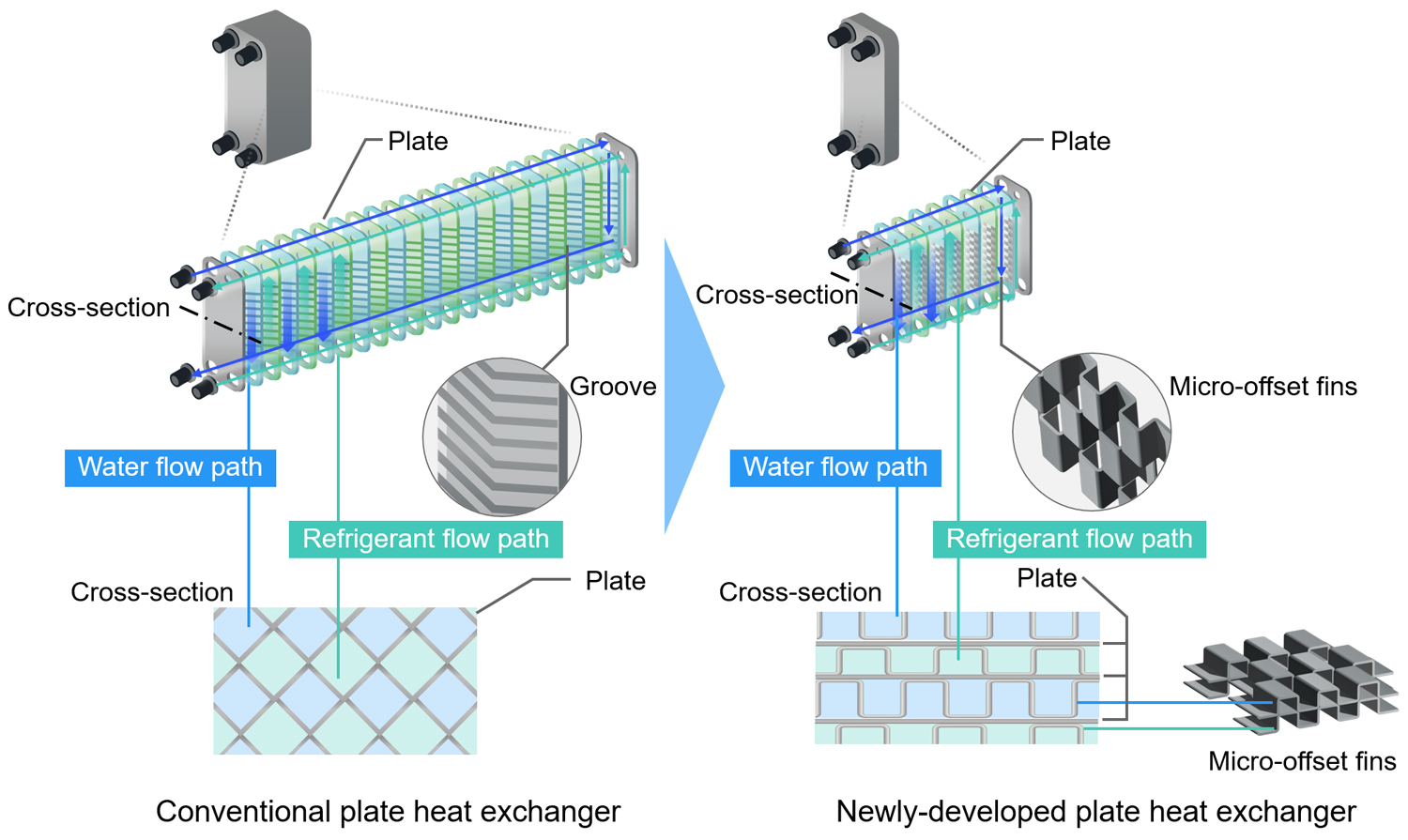
Further improvements in heat transfer performance are constrained by the limitations of conventional heat exchanger designs. Mitsubishi Electric investigated the use of micro-offset fins⁴ between flat plates to enhance heat transfer. Testing revealed, however, that this configuration resulted in non-uniform distribution of the refrigerant’s gas-liquid two-phase flow across the entire plate surface.
This represented one of the key engineering challenges in developing the new heat exchanger.
How the New Technology Works
To achieve more uniform flow distribution, Mitsubishi Electric developed specially designed distribution channels at the refrigerant inlet and outlet.
These channels enable uniform distribution of the refrigerant’s gas-liquid two-phase flow across the plates. The channel arrangement was optimized using Mitsubishi Electric’s proprietary analytical technology, which simulates the complex flow behaviour of two-phase refrigerants between the fine fins.
As a result, Mitsubishi Electric has achieved industry-leading² heat transfer performance while reducing the required refrigerant charge.
Applications Across a Wide Range of Heat Pump Systems
The newly developed technology has the potential for application across a wide range of systems, including:
- Water-based heating and cooling systems;
- Air-cooled air conditioning systems;
- Heat pump systems for electric vehicles (EV).
Mitsubishi Electric plans to integrate the technology into various products across its portfolio as part of its efforts to reduce environmental impact and support the transition to carbon neutrality.
ClimaCom is the official representative of Mitsubishi Electric HVAC solutions in Bulgaria. For more information about Mitsubishi Electric heating, cooling and ventilation systems, you can contact our team or explore our product portfolio.
Source: Mitsubishi Electric Global
¹ A heat pump system that transfers heat from the environment, such as air or water, for the purpose of heating or cooling.
² As of September 14, 2026, according to a Mitsubishi Electric study on plate heat exchangers for heat pump equipment.
³ Compared with Mitsubishi Electric’s conventional plate heat exchangers.
⁴ Fine fins arranged in a staggered configuration to promote turbulence and enhance heat transfer.