Climacom

Banner precision air conditioning for server rooms

Cooling

independent temperature control

Precise temperature and humidity control

High energy efficiency

Low noise levels

Weekly timer

Compact dimensions

Precise temperature and humidity control

An increasing number of companies are choosing to store their data locally in corporate data centers.
Modern IT environments are characterized by variable thermal loads, which require high cooling capacity at full load to ensure reliable operation of equipment when it is most critical.

Designing the optimal IT cooling system

Two key factors define the ideal system: load density and cooling capacity. Mitsubishi Electric’s extensive product range enables precise matching of these parameters to meet the specific requirements of each application.

The available specialized IT solutions include DX systems designed specifically for IT environments, as well as options compatible with Mitsubishi Electric’s standard HVAC outdoor units—ensuring seamless integration and expanded application possibilities.

Efficiency and reliability

Our range of specialized IT cooling systems maintains stable conditions even under significant load fluctuations, ensuring an optimal microclimate throughout the year.

Mitsubishi Electric prioritizes efficiency and reliability at every stage—from design to manufacturing. With over 50 years of experience in IT cooling, we deliver solutions that reduce operating costs through high-efficiency technologies.

What is load density?

In IT cooling, load density refers to the amount of cooling capacity required to dissipate the heat generated by IT equipment within a single rack (RAC cabinet).

  • Low density: below 5 kW
  • Medium density: 5–15 kW
  • High density: above 15 kW
Low density

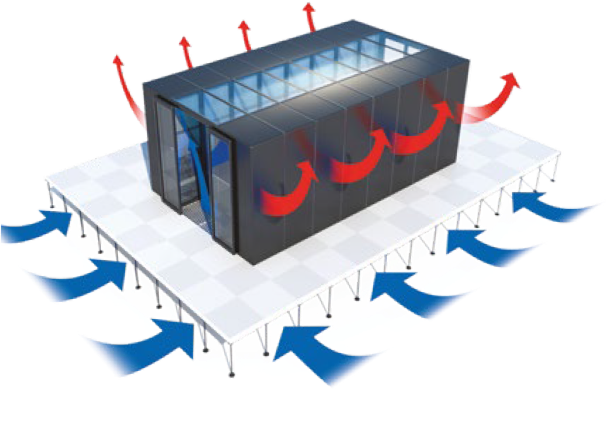
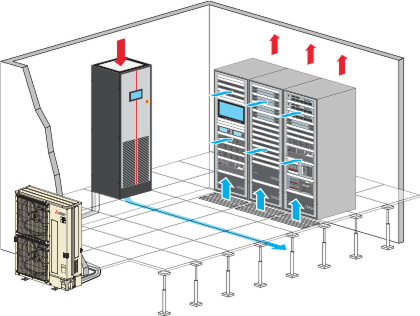
Computer room air conditioning systems (CRAC) are typically installed along the perimeter of the room.
They draw in warm air from the server racks, while the cooled air is supplied through a raised floor and delivered via floor grilles to the front of the racks—creating hot and cold aisle configurations.

ChatGPT Image Jan 23, 2026, 04 19 19 PM

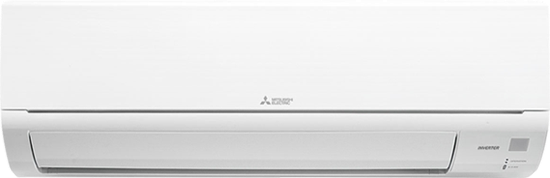
M Series MSY-TP R32

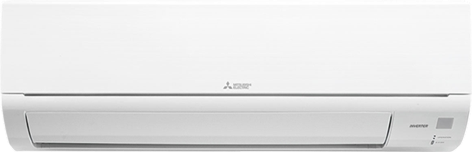
The M-Series MSY-TP air conditioning system combines energy efficiency with a modern design.
This cooling-only model offers high cooling capacity, making it an ideal solution for low-density data centers and smaller installations, as well as for spaces requiring a higher proportion of sensible cooling.

  • High sensible cooling capacity
  • Cooling operation at outdoor temperatures down to –25°C
  • High energy efficiency
  • Weekly timer for precise control
  • R32 refrigerant
Layer 42
Medium density

In medium-density applications, perimeter CRAC units are combined with aisle containment systems. In this configuration, cold and hot airflows are physically separated, preventing air mixing and eliminating the risk of hot spots.

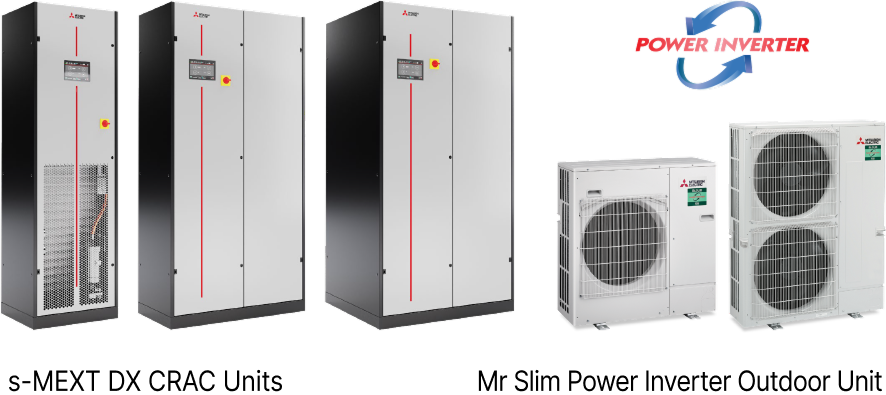
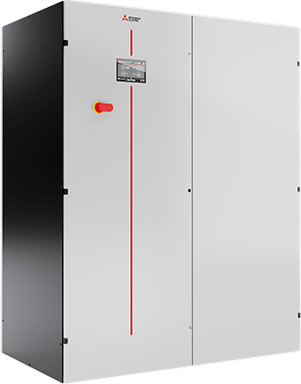
s-MEXT DX Close Control system

The split cooling system consists of an s-MEXT indoor unit—a precision air conditioner—connected to a Mr Slim Power Inverter outdoor unit. The result is a fully inverter-driven split system, designed to the highest quality standards and intended for mission-critical IT environments.

  • Hybrid solution combining packaged modules and customized equipment
  • Plug & play technology with piping lengths up to 100 m
  • Proven and reliable technology
  • Compact design
  • High energy efficiency

The s-MEXT DX system can be connected to both new Power Inverter outdoor units using R32 refrigerant and systems operating with R410A.
The use of a Power Inverter outdoor unit significantly simplifies installation and allows easy sizing of piping diameters.

Vector Smart Object
Group 22
High density

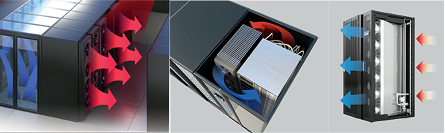
For high-density applications, localized cooling solutions are used to meet increased thermal loads. These include in-row, in-rack, and rear door coolers, which deliver conditioned air directly to the server inlets—ensuring optimal temperature control within each rack.This approach is widely known as close-coupled cooling.

Vector Smart Object 4

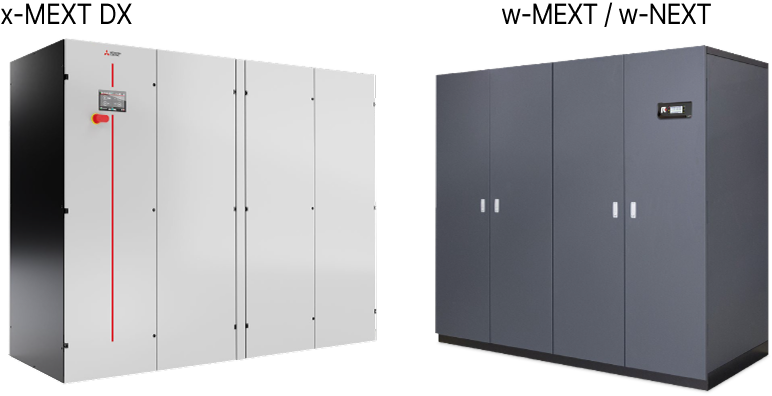
x-MEXT DX / w-MEXT / w-NEXT

The x-MEXT DX, w-MEXT, and w-NEXT series maintain stable temperature and humidity levels even under significant load variations, providing high-performance sensible cooling.

  • Perimeter units with upflow and downflow configurations
  • Ultra-light composite EC plug fans for reduced noise and lower energy consumption
  • Integrated control of up to 10 units for intelligent system management
  • Automatic restart after power failure
  • Return air temperature limits up to 40°C
  • Optional Modbus RS485 and BACnet TCP/IP connectivity
  • Optional electric heaters and steam humidifiers
Group 23

Airflow configuration

As with the s-MEXT DX, the x-MEXT DX and w-MEXT / w-NEXT systems are available in both downflow and upflow configurations, providing flexibility for installation across a wide range of applications.

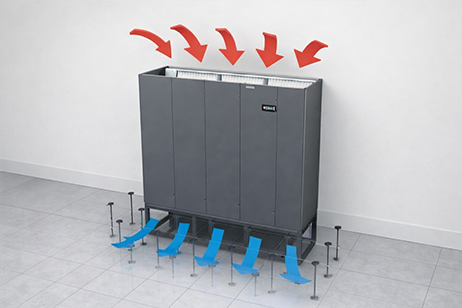
Downflow

In downflow configuration, air is drawn from the top of the unit and supplied into the raised floor plenum.

Downflow

Upflow

In upflow configuration, air intake is from the front, rear, or bottom of the unit, while conditioned air is discharged from the top—either into ductwork in the ceiling void or through front-mounted distribution plenums.

Downflow

Digital world, real emissions

In an increasingly digital world, data centers form the backbone of modern infrastructure. They support everything from commerce and education to entertainment, while also generating a significant energy footprint. Globally, data centers account for approximately 2%–3% of carbon emissions, a figure expected to rise.

At the same time, the shift toward smaller, edge data centers is accelerating.
These decentralized facilities, located closer to end users, reduce latency and improve energy efficiency. While hyperscale data centers remain leaders in technological efficiency, smaller installations must also adopt intelligent cooling and energy strategies to meet global sustainability goals.

Mitsubishi Electric – turning waste heat into a resource

Mitsubishi Electric has extensive experience in recovering waste heat from data centers and utilizing it to supply district heating networks worldwide. A key insight from practical experience is that—whether for new or existing infrastructure—the first step is to assess whether there is a real local demand for the recovered heat, or whether an existing network can accommodate additional capacity. This is a critical factor for the effective and sustainable use of this valuable energy resource.

Follow us on social media to discover engaging, up-to-date and valuable content.